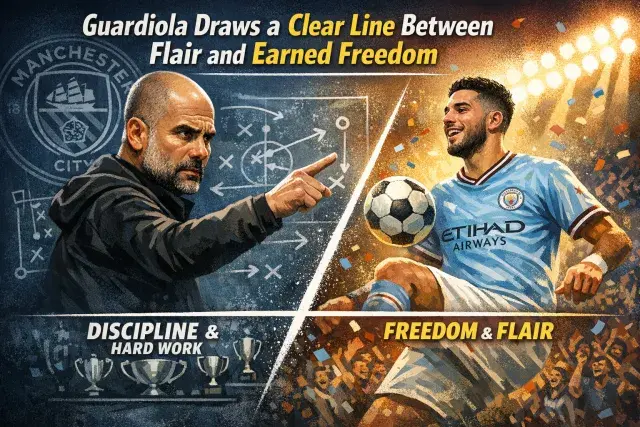
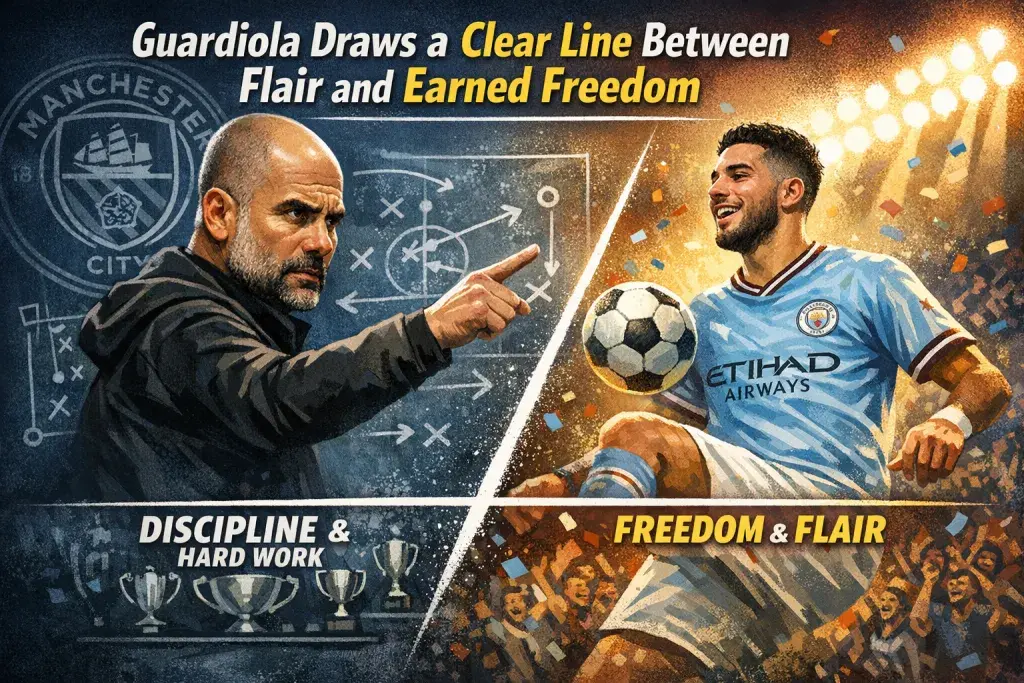
Rayan Cherki arrived at Manchester City in the summer of 2025 with a price tag of £34 million and a reputation built on audacity. His instinct to entertain — to juggle the ball in open play, to execute a Rabona cross when a straightforward pass would do — has divided opinion since his arrival. Now, former City midfielder Gareth Barry has articulated, with unusual clarity, what Pep Guardiola's private message to the 22-year-old Frenchman almost certainly is: earn the right first, then express yourself freely.
The Incident That Sparked the Debate
The flashpoint came during City's Carabao Cup final victory over Arsenal. With the result moving firmly in City's favour, Cherki broke into a sequence of ball-juggling that drew immediate reaction from commentators. Gary Neville, on co-commentary duty, called it "a little bit arrogant." Former Premier League manager Alan Pardew was more direct, describing it as "an insult in the pro game." The criticism was not without basis. In professional football culture, showboating during a live fixture — particularly before a result is mathematically secured — carries a specific charge: disrespect to the opposition, and a prioritisation of personal expression over collective discipline.
Yet the backlash was far from unanimous. A significant portion of supporters and pundits welcomed the moment precisely because it was unusual. The modern professional game, optimised to within an inch of its life, has largely squeezed out the instinct to simply enjoy the act of performing. Cherki, in that brief sequence, represented something genuinely rare.
What Barry Says Guardiola Will Demand
Speaking exclusively to GOAL courtesy of BetMGM, Barry offered a nuanced reading of how Guardiola is likely to handle the situation. "I think Pep will be making a point: you're not quite ready to do that at the moment," Barry said. "Keep scoring goals, keep playing how you've been playing, win some more trophies here — then the keepy-uppies, you can do them as often as you want." Barry was careful not to frame this as an outright prohibition. His interpretation is that Guardiola's objection is not to flair itself, but to flair deployed before the individual has established the statistical and collective credibility that makes it forgivable, even celebrated.
This is a meaningful distinction. Guardiola has worked across his career with some of the most expressive creative forces in European football — Lionel Messi, Franck Ribery, and currently Jeremy Doku and Savinho. He has not suppressed them. What he has consistently demanded, however, is that individual expression remain subordinate to collective output. The criticism levelled at Guardiola over his handling of Jack Grealish — widely seen as having curtailed rather than cultivated Grealish's creative instincts — suggests the balance is genuinely difficult to strike, and that Guardiola does not always get it right.
The Cultural Lineage Cherki Represents
Cherki belongs to a specific and identifiable tradition in football: the entertainer as cultural figure. Ronaldinho and Neymar, both Brazilian and both broadly invoked whenever Cherki's style is discussed, understood the game as simultaneously a competitive and performative event. For them, the crowd was not a backdrop but a participant. A flicked turn, a no-look pass, or a piece of ball-juggling was not self-indulgence but communication — a kind of dialogue with the audience that reaffirmed why the game holds the cultural weight it does.
This tradition has always existed in tension with the professionalised, data-driven model that dominates elite football management. Guardiola represents the apex of that managerial model. The fact that he has consistently chosen to work with players from Cherki's mould — rather than avoiding them — suggests he values what they bring, even if managing them demands a particular kind of patience and precision.
The Path Forward for Cherki
Thierry Henry, who worked with Cherki during the 2024 Paris Olympics, has expressed confidence that the Frenchman will "accomplish exceptional things." Erling Haaland has drawn comparisons between Cherki's ability and that of Kevin De Bruyne — City's most decorated creative force of the past decade. These are not casual endorsements. They indicate a broad consensus, within the professional environment closest to Cherki, that the raw material is exceptional.
What Barry's analysis underlines is that Guardiola's response to Cherki is less about suppression and more about sequencing. The freedom to perform must be underwritten by production. Once Cherki's goals, assists, and decisive contributions accumulate to a level that places him beyond reasonable criticism — once the numbers speak as loudly as the tricks — the expressive moments become part of the narrative rather than a distraction from it. That, according to Barry, is the message Guardiola is delivering. Not a prohibition. A timetable.