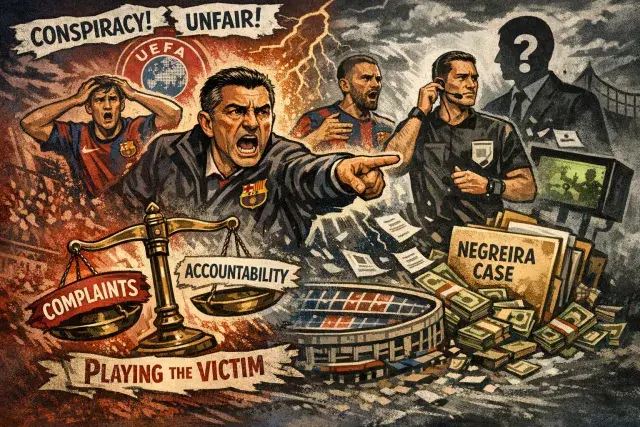
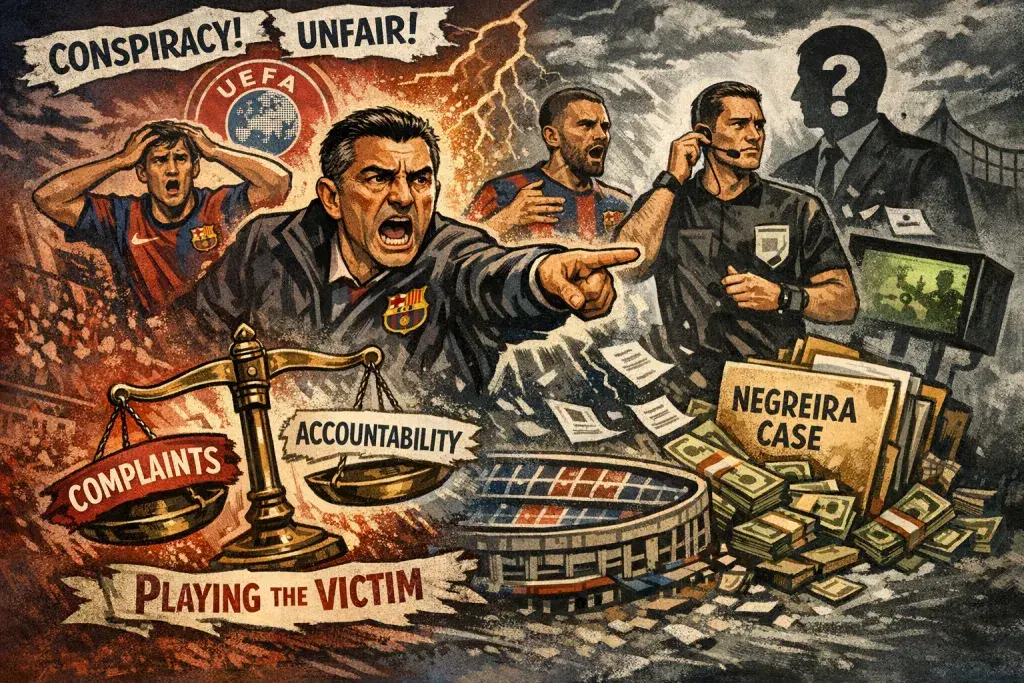
Losing narrowly while playing the better part of a contest with ten men would frustrate any organisation. But Barcelona's response to Wednesday's Champions League defeat at the hands of Atletico Madrid — a formal legal complaint to UEFA accompanied by insinuations of systemic bias against the club — crossed the line from legitimate grievance into institutional bad faith. The problem is not that Barcelona complained. The problem is the pattern behind the complaint, and what that pattern says about a club that has spent years cultivating a persecution narrative while refusing to apply the same scrutiny to itself.
A Complaint With a Kernel of Truth, and a Conclusion Built on Nothing
There was, in isolation, a defensible point buried within Barcelona's statement. Footage of the incident involving goalkeeper Juan Musso in the Atletico penalty area did show a degree of ambiguity about whether play had been properly restarted before Marc Pubill touched the ball. Submitting that specific concern to UEFA for review would have been a proportionate, professional response. Clubs raise officiating questions through proper channels routinely, and there is nothing inherently wrong with doing so.
What Barcelona chose to do instead was use that narrow, arguable incident as a launchpad for something far more sweeping: a claim that the club has been subjected to a "clear double standard" in recent editions of Europe's premier club competition, and that refereeing decisions have systematically prevented them from "competing on a level playing field." No evidence was provided. No specific pattern was documented. The allegation was asserted as if its own repetition constituted proof.
This matters beyond football culture because it reflects a broader rhetorical strategy recognisable across institutions and public life: take a legitimate specific complaint, attach it to a grand conspiratorial claim, and use the emotional credibility of the former to carry the latter past scrutiny. It is a tactic that corrodes public trust in officiating bodies, in institutional processes, and ultimately in honest dispute resolution itself.
The Negreira Affair and the Cost of Institutional Hypocrisy
Barcelona's accusations of bias carry a particular weight — and not the weight the club intends. The club faces serious, documented allegations relating to payments totalling €8.4 million made over many years to companies linked to José María Enríquez Negreira, who served as vice-president of Spain's National Committee of Referees during the relevant period. The precise legal outcome of that case has yet to be fully determined, but the facts of the payments themselves are not in dispute.
For a club operating under that shadow to publicly declare itself the victim of refereeing corruption, without producing a shred of concrete evidence, is not just tactically unwise. It is a form of institutional brazenness that demands direct acknowledgment. Organisations under genuine scrutiny for past conduct are held to a higher standard of evidential rigour when making accusations against others. Barcelona's legal department appears not to have received that memo.
The irony is compounded by the club's own recent history with VAR. Just four days before the Atletico defeat, a VAR intervention in the Liga fixture between the two clubs at the Metropolitano led to a red card for Barcelona's Gerard Martin being downgraded to a yellow — a call Spain's refereeing committee subsequently ruled should never have been made, as the original dismissal should have stood. That intervention benefited Barcelona materially in a title race where they currently lead by nine points. No statement from the club's legal department followed.
Hansi Flick and the Failure of Self-Awareness
What makes this episode particularly striking is that Hansi Flick, Barcelona's head coach, had previously spoken with notable clarity about the culture of blaming officials. Commenting on Real Madrid's threat to withdraw from the 2024-25 Copa del Rey final over alleged official hostility, Flick said: "What's happening isn't right. We can't lose respect for referees. This is football, and it's our responsibility to protect everyone: players, coaches, and referees. On the pitch, there are emotions, but after the match, we must move on."
Those are precisely the right words. They reflect a mature understanding of why institutional respect for officiating is essential to the credibility of organised competition. The tragedy is that Flick himself abandoned that position less than two weeks later, after Barcelona's elimination from last season's semi-finals, when he confronted the referee after the final whistle and told the press that "every decision that was 50-50 ended up being in their favour." His players followed his lead, with Pedri calling for a UEFA investigation into the referee's conduct — an allegation the official in question, Szymon Marciniak, correctly described as ridiculous.
Coaches shape cultures. When a leader publicly signals that blaming officials is an acceptable response to defeat, players internalise it. The behaviour cascades. What Flick modelled after that semi-final loss has now been institutionalised into a legal procedure filed within 24 hours of the Atletico result. The club has taken its coach's post-defeat instinct and given it a letterhead.
The Broader Cost of a Grievance Identity
There is something genuinely self-defeating about this trajectory for a club with Barcelona's footballing heritage. The institution built its modern identity on a coherent, principled philosophy of development and technical excellence rooted in the teachings of Johan Cruyff. Its academy has produced generations of technically exceptional performers. Its commitment to developing young talent is not marketing — it is structural, embedded in the club's sense of its own identity and its relationship with Catalan culture and community.
Lamine Yamal's emergence at 18 is not a commercial talking point. It is the latest expression of a developmental model that has few peers in European football. This is a club with genuine reason for pride and genuine cause for optimism about its competitive trajectory.
But none of that heritage is served by a culture that responds to difficult defeats with accusations of conspiracy. Grievance identities are corrosive precisely because they offer an alternative explanation for failure that requires no self-examination. If officials are always against you, there is no need to ask whether your squad depth is sufficient, whether your tactical vulnerabilities were exposed, or whether opponents simply executed their plan better on the night. The conspiracy becomes a comfort, and comfort, in competitive environments, is the enemy of improvement.
Barcelona are not alone in this. The culture of blaming officials is endemic across elite European club football, with their own fiercest rivals having indulged in precisely the same behaviour. But endemic does not mean acceptable. And a club that positions itself as a standard-bearer for a certain kind of sporting values — one that lectures rivals on their conduct — has surrendered the right to be surprised when it is held to its own stated standards.